Installation Process
The Block Paving Installation Process Builds Epsom Driveways from the Ground Up
A block paving driveway is built in eight ordered stages, from survey through to a final check of levels and finish. Each stage depends on the one before it being done properly.
What Are the Stages of Block Paving Installation?
Installation runs from survey and excavation through to jointing and a final finish check, in this order:
- Survey and setting out, marking the exact area and levels for the new driveway
- Excavation to the depth required for the sub-base, edge restraints and paving above it
- Installing edge restraints to define and hold the outer edge of the driveway
- Building and compacting the sub-base in layers to the specified depth
- Laying and screeding the bedding/laying course that the blocks sit on
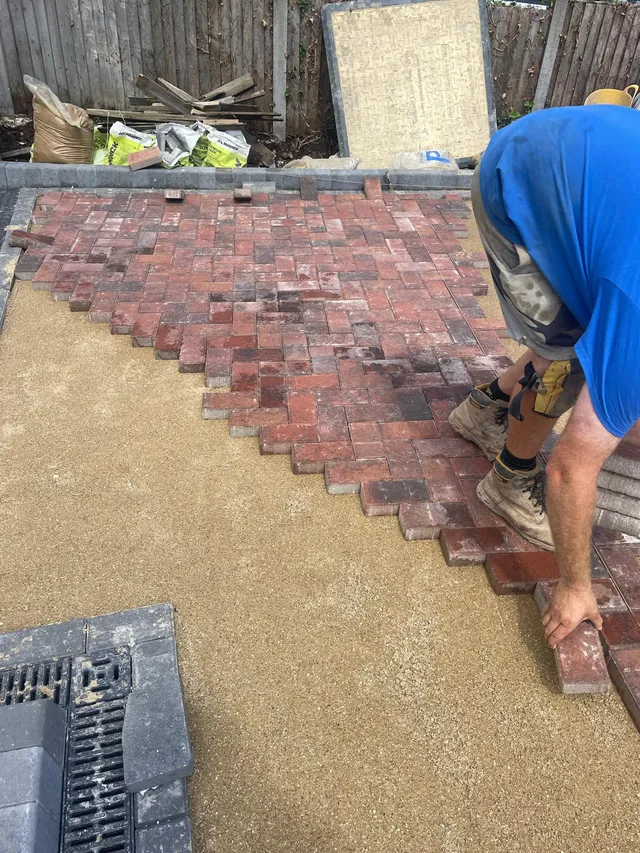
- Laying the blocks to the chosen pattern, cutting neatly around edges and features
- Jointing the surface and compacting the whole area to lock the blocks together
- A final check of levels, falls and finish before the site is cleared
What Happens at Each Stage?
Each of the eight stages has its own purpose, and skipping detail at any one of them can affect the finished driveway. Here is what actually happens at each step.
1. Survey and Setting Out
Before any digging starts, the exact area of the new driveway is measured and marked out, including levels, falls and where the edges will sit.
This stage also confirms access for machinery and materials, and flags anything, such as manhole covers or existing drainage, that the rest of the build needs to work around.
2. Excavation
The existing surface, whether that is turf, soil or an old driveway, is removed down to the formation level needed for the sub-base, edge restraints and paving above it.
See block paving excavation in Epsom for how this stage is carried out in more detail.
3. Edge Restraints
Edge restraints are installed around the perimeter of the excavated area before the sub-base is built up, since they define and hold the outer edge of the finished driveway.
Getting this stage right matters more than it looks: a poorly installed restraint is one of the most common causes of blocks spreading and loosening later on.
4. Sub-Base Construction
A graded stone sub-base is built up and compacted in layers to the depth specified for your ground conditions and expected use.
See what sub-base a block paving driveway in Epsom needs for why the depth and material matter so much to how the finished driveway performs.
5. Laying Course
A thin bedding layer, known as the laying course, is spread and screeded evenly over the compacted sub-base. This is what the blocks actually sit on.
Getting this layer consistent and level is what allows the finished blocks to sit flush and even across the whole driveway.
6. Laying the Blocks
Blocks are laid to the chosen pattern, working methodically across the driveway and cutting neatly around edges, manholes and other features.
This is usually the most visually satisfying stage to watch, as the finished surface starts to take shape.
7. Jointing and Compaction
Once the blocks are laid, jointing sand is brushed into the gaps between them and the whole surface is compacted with a plate compactor.
This locks the blocks together as a single interlocking surface, rather than a collection of loose individual pieces.
8. Final Check and Handover
Levels, falls and the overall finish are checked before the site is cleared and any waste is removed.
We talk you through the finished driveway and any care guidance before considering the project complete.
Why Does the Order of Stages Matter So Much?
Excavation and sub-base work determine whether your driveway stays level for years or starts to move within a season, so skipping or rushing a stage rarely saves time overall.
Rushing the laying course or jointing stage can leave a driveway looking finished on day one, while creating problems that only appear months later.
Falls and levels are built in during excavation and sub-base construction, not added afterwards. See block paving drainage in Epsom for why this stage matters for surface water.
What Should I Expect During My Installation?
As part of a new block paving driveway installation, we talk you through each stage before it happens. This means you know what to expect and roughly how long each part will take.
See how long block paving installation takes in Epsom for what typically affects the overall timescale.
This process is carried out by Epsom's block paving driveway specialists.
Ask About the Installation Process for Your Driveway
Tell us about your driveway and your plans. There is no phone call needed; everything is handled through the form below.